.
science bulletin,2025
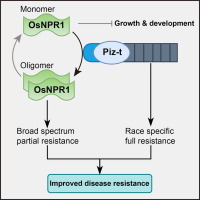
plants have developed a set of defense mechanisms against pathogen infection. basal immunity provides broad-spectrum resistance (bsr) but weak resistance to various pathogens, while resistance (r) gene-mediated effector-triggered immunity (eti) confers strong but race-specific resistance to limited pathogens. salicylic acid (sa) is a key plant immune hormone, and its receptor, the nonexpressor of pathogenesis-related genes 1 (npr1), is a positive regulator of plant basal immunity. although overexpression ofnpr1enhances immunity in various crops, these overexpression plants showed growth defects and yield losses, posing challenges for the application ofnpr1in crop improvement.rgene-mediated eti is widely used in molecular breeding. for example, ricergenespi9,piz-t, andpigmare important breeding resources with bsr to manymagnaporthe oryzaeisolates and have been incorporated in elite rice varieties. however, isolates in the paddy field are often a mixed population, and in this complex environment,rgene-mediated resistance often lacks durability and broad-spectrum efficacy. therefore, how to coordinate the two immune systems becomes a bottleneck in improving crop resistance.
science bulletin,if=21.1

